

Contact us

Get in touch with Jadestone Energy

Jadestone Energy (Australia) Pty Ltd
The Atrium Building
Level 2, 168 St Georges Terrace
Perth, Western Australia, 6000

+61 8 9486 6600

Jadestone Energy (S) Pte Ltd
Talavera Suite 10th Floor, Unit 05-06
Talavera Office Park, Jl. TB Simatupang
Kav.22-26, Jakarta 12430 Indonesia

+62 21 8066 9020

Jadestone Energy (Singapore) Pte Ltd
3 Anson Road
#13-01 Springleaf Tower
Singapore 079909

+65 6324 0359

Mitra Energy (Vietnam Phu Khanh) Pte Ltd
Unit 07-22 The Executive Centre, Level 7
Friendship Tower, 31 Le Duan Boulevard
Ben Nghe Ward, District 1
Ho Chi Minh City, Vietnam

+84 28 38 237 111

Jadestone Energy plc
Human Resources team

careers@jadestone-energy.com

Phil Corbett
Investor Relations Manager

+44 7713 687467
ir@jadestone-energy.com

James Crothers, Billy Clegg
CAMARCO (Financial PR)

+44 (0)203 7574980
jse@camarco.co.uk

Online enquiry

Leave us your details and enquiry below and we will get back to you as soon as possible.

Enquiries

Subscribe to our mailing list

Subscribe to our mailing list

nl subscription

"*" indicates required fields

Energy Transition

Fit for the energy transition

With its focus on acquiring and maximising the life of fields already in production, as well as developing discovered gas resources, Jadestone is well positioned for the energy transition.

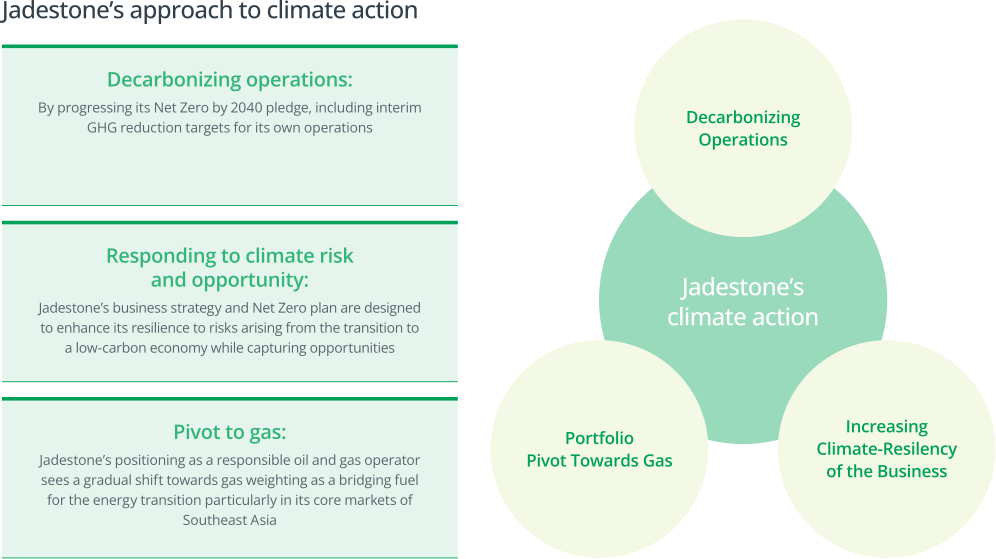
Jadestone’s multi-faceted approach to the energy transition includes decarbonising operations, managing climate risks and opportunities, and pivoting towards gas.

Jadestone's strategy is fit for the energy transition, as existing fields and discoveries can fulfill global hydrocarbon demand without requiring new resource additions through exploration. Jadestone’s strategy explicitly precludes frontier exploration and new greenfield development, a position that is in line with the IEA’s Net Zero Emissions by 2050 Scenario.

Executive Chairman

Dr Adel Chaouch

Dr Adel Chaouch

Executive Chairman

"Jadestone's strategy is fit for the energy transition, as existing fields and discoveries can fulfill global hydrocarbon demand without requiring new resource additions through exploration. Jadestone’s strategy explicitly precludes frontier exploration and new greenfield development, a position that is in line with the IEA’s Net Zero Emissions by 2050 Scenario."

2024 highlights

B score for CDP1 climate reporting

Year-on-year improvement (2023: C) and better than global average

Scope 3 data integrity

Improved reporting accuracy

31,471 carbon credits2

Purchased and surrended in Australia (Previous compliance year: Nil)

1CDP: formerly known as Climate Disclosure Project
2Australian Carbon Credit Units (ACCUs) for compliance during the Australian financial year ending June 2024

Net Zero roadmap

Jadestone is committed to achieve Net Zero on its Scope 1 and 2 greenhouse gas (“GHG”) emissions from operated assets by 2040.

Jadestone is set on reducing its Scope 1 and 2 GHG emissions by 20% by 2026 and by 45% by 2030 from 2021 levels. The interim targets will be achieved through a combination of measures, ranging from operational GHG reductions, reliance on carbon credits within the regulatory schemes of Jadestone regions as well as natural field decline.

Jadestone’s implementation roadmap includes latest business plans and forecasts, which are based on assumptions, contingencies, and commercial judgement, which will be subject to at least an annual review.

Jadestone’ plays a key role as a steward of existing assets, ensuring that real-world emissions do not go up as assets change hands;

Through the development of gas, it contributes to regional energy security and lowered GHG emissions by displacing higher-emitting fuel sources.

Refer to Jadestone’s 2024 Sustainability Report to view the Group’s GHG emissions data.

Responding to climate risk

Climate change and energy transition represent a paramount challenge for the energy sector and society at large. Jadestone is actively assessing climate risks and opportunities, strategically building resilience for its business.
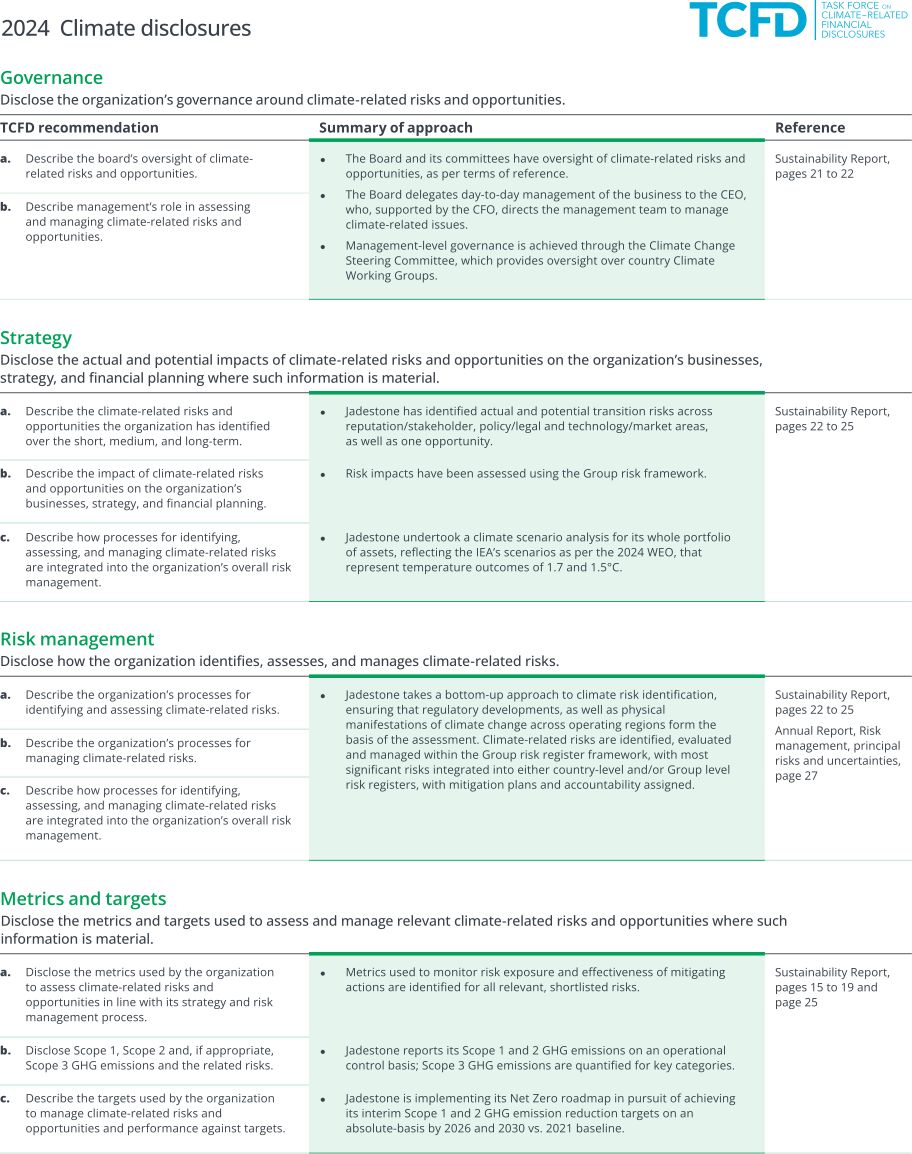
Jadestone consults the recommendations of the Task Force on Climate-Related Financial Disclosures (“TCFD”) to inform its approach to managing and disclosing climate-related risks and opportunities.

Refer to the table below for the key highlights of the ongoing efforts to improve climate-related disclosures.