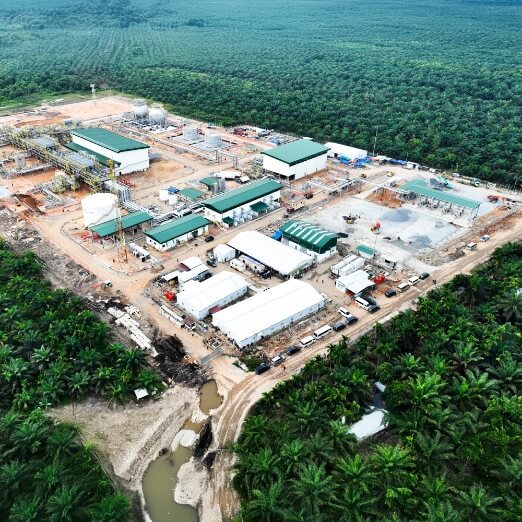
Minimising biodiversity impacts at the Akatara Gas Processing Facility
Jadestone’s AGPF is situated on an existing brownfield site onshore Sumatra, Indonesia, primarily within areas of low to medium conservation value, such as agricultural land and peat-protected zones.
Equator Principles and IFC Performance Standards
Construction and commissioning activities were in full swing during the first half of the year, with first gas introduced in June 2024. The project continued to make progress towards full compliance with the Equator Principles and IFC Performance Standards (IFC PS), which are the key deliverables for Jadestone’s financing. A reputable third party has visited the site during the year to verify compliance against IFC PS, highlighting the progress towards implementing environmental and social practices as per its Environment and Social Action Plan.
Biodiversity Action Plan
In 2023, Jadestone engaged local specialists to conduct a critical habitat assessment, rapid biodiversity risk screening, and additional biodiversity surveys as required by IFC PS6. Based on these studies, Jadestone developed a Biodiversity Action Plan (BAP). The BAP focuses on reducing Jadestone’s biodiversity impact by identifying mitigation measures to ensure no net loss of biodiversity values. Jadestone has committed to long-term monitoring for species or habitats of high conservation value within the project area.
Implementation progress
Jadestone has continued its efforts during the year to revitalise an over 5km long canal stretch. A well-maintained canal ensures that farmers have enough water to support farming and, in rainy season, helps with flood prevention.
Jadestone is also undertaking watershed rehabilitation near the site, allocating 110% of the project area for planting woody plants and multipurpose tree species to mitigate watershed degradation, prevent flooding, landslides, and drought, while improving biodiversity outcomes for local communities.
Further, the BAP also includes initiatives to enhance community livelihoods through access to ecosystem services such as fisheries, livestock, and agriculture. A Forest Farmer Group has been formalised during 2024 to support the government efforts in promoting sustainable management of forests while enhancing livelihoods. A 61-hectare area has been successfully planted with wood and eucalyptus trees. A potential development of a small eucalyptus oil industry is being investigated as an opportunity for a new source of income for the communities.